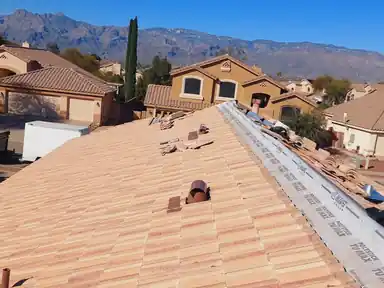
Roofing Services in Tucson
Tile, shingle, and flat roofs, plus the coatings, gutters, and skylights that decide where the water ends up. Every job starts with a free assessment and a written scope with photos.
Leak repair
Roof Repair
Leaks chased back to the point water is actually getting in and repaired there, with photos of what was behind the failure. Tile, shingle, and flat roofs.
A roof leak is a symptom. The water you see on the ceiling got in somewhere else (a cracked flashing, a lifted shingle, a split seam, a failed vent boot, a gap where the roof meets a wall) and then followed a rafter, a truss, or the deck until it found a place to drop. A repair that treats the wet spot instead of the entry point is a repair you pay for twice.
Signs you need it
- A ceiling stain that grows after every storm A stain that darkens or spreads after rain means water is still getting in, and the insulation and drywall above it are soaking up more than you can see.
- Cracked flashing or split vent boots The metal and rubber pieces at walls, chimneys, and pipe penetrations take a beating from the sun. When they crack or pull loose, water has an easy way in.
- Missing, cracked, or displaced roofing A missing shingle, a cracked tile, or a torn patch of membrane leaves the layer underneath exposed. It may hold for a while, but it was never meant to be the top layer.
- A musty attic or damp insulation If the attic smells musty or the insulation is damp or matted down, water has been getting in for a while, usually slowly enough that it never reached the ceiling.
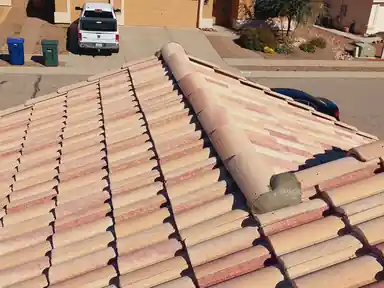
Replacement & reroofing
Roof Replacement
Full replacements, reroofs, and new roofs for additions and new construction, with the deck checked and fixed while it is exposed instead of buried under the new roof.
When a roof is done, the question is not only what goes on top. It is what is underneath. On a full replacement everything comes off down to bare deck, which is the one moment in a roof's life when the sheathing can actually be seen. Soft, delaminated, or water-damaged decking gets swapped then, while it is visible, and the new system goes on over a deck that can hold it.
Signs you need it
- Leaks in new places every season Fixing one leak only for another to open somewhere else is what a roof at the end of its life looks like. At some point the repairs cost more than they save.
- Worn-out material across the whole roof Brittle, curling shingles everywhere, underlayment failing under the whole tile field, or a flat roof blistered edge to edge means the problem is not one spot. It is the roof.
- A deck that gives underfoot Soft or spongy spots mean the sheathing has been wet long enough to lose strength. That damage stays hidden until the roofing comes off, and it only spreads while it is covered.
- A sagging roofline or daylight in the attic A dip in the roofline, or light showing between boards in the attic, points to decking or framing problems that need to be looked at before any new roofing goes on.
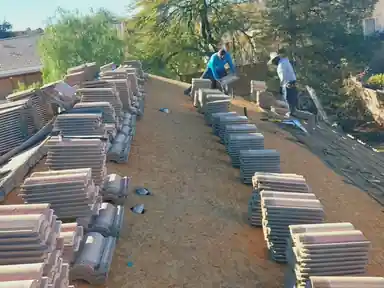
Leaks & storm damage
Emergency Roof Repair
Active leaks and storm damage jump the queue. We get out, find where the water is getting in, and stop it before the permanent repair is even quoted.
When water is coming through the ceiling, or a monsoon storm has torn part of the roof open, the first job is not the repair. It is stopping the damage from growing. Every hour an opening stays open, more water reaches the insulation, the drywall, and the framing, and what started as a roof problem becomes an interior one.
Signs you need it
- Water actively coming into the house Dripping from a ceiling, a light fixture, or down a wall means water has a path in right now, and it is spreading further than you can see.
- Part of the roof torn open or missing Wind can peel back shingles, lift a section of membrane, or throw tiles. Anything that leaves the deck or underlayment exposed needs covering before the next band of rain.
- A branch or debris through the roof An impact can crack decking and framing as well as the roofing. It needs closing up and a proper look before anyone assumes the damage stops at the surface.
- A ceiling that is sagging or bulging A bulge in the ceiling usually means water is pooling above it. Keep people and belongings out from under it and call right away.
What we handle
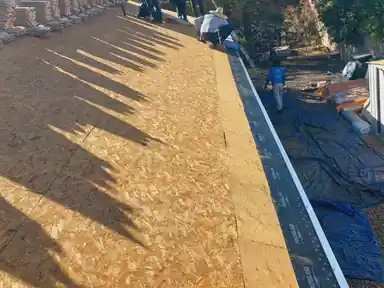
Inspections & maintenance
Roof Inspection & Cleaning
Every plane, penetration, and edge checked, then a written report with photos that you can hold a contractor to, including us.
Most roofs only get looked at when something goes wrong. An inspection flips that around. We check the whole roof (every plane, every penetration, every edge and transition, the flashing, the drainage, and the gutters and skylights tied into it) and then write down what we found, with photographs to back it up.
Signs you need it
- Nobody has been up there in years Roofs age quietly. Cracked flashing, slipped tile, and worn coating rarely show from the ground until they turn into a leak.
- Right after a big monsoon storm Wind and heavy rain do damage you cannot see from the yard: lifted shingles, broken tiles, debris packed into valleys. Catching it before the next storm costs far less than catching it after.
- Before buying or selling a home A roof report tells a buyer what they are taking on and gives a seller the chance to fix problems before they turn into a negotiating point.
- Staining, debris, or buildup on the roof Dirt, leaves, and staining hold moisture against the surface and hide what is underneath. If the roof looks neglected from the ground, it is worth a closer look and a careful cleaning.
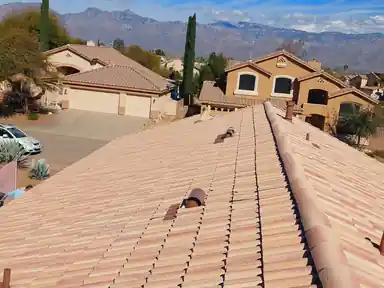
Concrete & clay tile
Tile Roofing
The tile on your roof can last for generations. The underlayment beneath it does not. We repair tile roofs, replace worn underlayment, and put your existing tile back on wherever it can be reused.
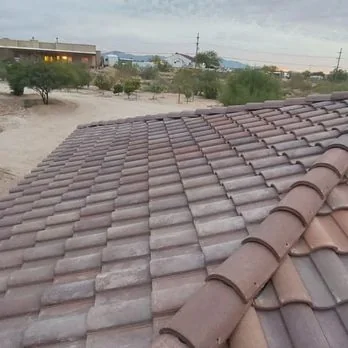
Concrete and clay tile are everywhere in Tucson, and for good reason: tile shrugs off the sun, will not burn, and lasts a very long time. But tile is not really what keeps the water out. It is a shield. The waterproofing is the underlayment beneath it, and on a roof that lives through Tucson summers, that underlayment wears out long before the tile does.
Signs you need it
- A leak with no broken tiles in sight When the tile looks fine and the ceiling says otherwise, the underlayment is the usual suspect. It is the layer doing the actual waterproofing, and it ages out long before the tile does.
- Cracked or slipped tiles Tiles crack under foot traffic (a solar crew, a satellite installer, an HVAC tech who did not know where to step) and slip when a fastener lets go. Either one leaves a gap straight down to the underlayment.
- Debris piled in the valleys Valleys carry more water than any other part of the roof. Leaves, seed pods, and wind-blown debris dam them up and push water sideways under the tile, right where the underlayment is already working hardest.
- Loose ridge mortar or birds under the eaves Mortar at ridges and hips cracks with heat and time and falls out in chunks. Open ends at the eave let birds nest under the first course. Both let water and weather in where they should not be.
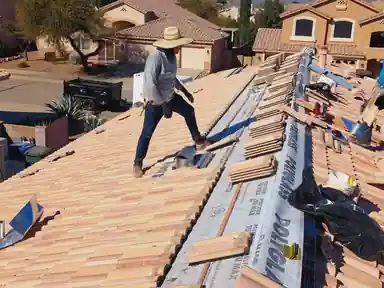
Asphalt shingle roofs
Shingle Roofing
Repair, replacement, and new asphalt shingle roofs, built for a climate that bakes shingles all summer and then throws monsoon wind at them.
Asphalt shingles are the most familiar roof in the country, but Tucson is hard on them. The asphalt is protected from the sun by a layer of mineral granules. UV and daily heat slowly loosen those granules, and once the asphalt underneath is exposed it dries out, stiffens, and starts to crack. In this climate that process simply runs faster than it does in a milder one.
Signs you need it
- Granules in the gutters or at the downspout Sandy grit collecting where your roof drains is the shingles' protective layer washing off. A little on a new roof is normal. A lot on an older one means the asphalt underneath is getting sun it was never meant to see.
- Edges curling up or tabs cupping Shingles that have dried out start to curl at the edges or cup in the middle. They stop sealing to each other, which is exactly the opening monsoon wind is looking for.
- Missing, creased, or flapping tabs after a storm A tab that was lifted and bent back leaves a crease line and a gap. Even if it is still attached, it has stopped keeping water out.
- A stain near a vent, chimney, or wall Ceiling stains that line up with a plumbing vent, a chimney, or the spot where a roof meets a second-story wall usually point to flashing or a cracked vent boot rather than the shingles, and those are very fixable.
What we handle
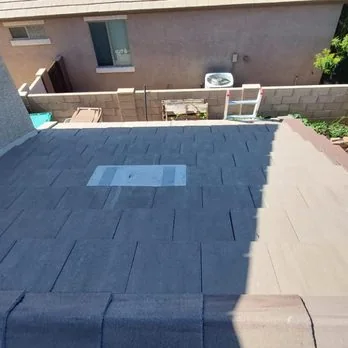
Flat & low-slope roofs
Flat Roof Repair
Most flat roof leaks show up nowhere near where they start. We trace the water back to the point it gets in, repair it there, and show you the photos.
A lot of Tucson is built flat: territorial and pueblo-style homes with parapet walls, ranch houses with a low-slope addition out back, patios and carports tied into the main roof. Those roofs are usually a base sheet and cap sheet, a built-up system, or a coated membrane, and they share one weakness. Water that gets under the surface travels along the deck before it finds a way down. The stain on your ceiling is where it came out, not where it went in.
Signs you need it
- Water still standing two days after rain Some water after a storm is normal. Water still sitting there 48 hours later means a low spot, a sagging deck, or a blocked scupper, and the membrane under that puddle is aging faster than the rest of the roof.
- A bubble in the cap sheet or a spot that gives underfoot A blister is air or moisture trapped between layers. A soft spot usually means the deck or insulation below has been wet for a while. Neither one fixes itself, and summer heat makes both grow.
- Cracks where the roof meets the parapet The inside corner where the membrane turns up the wall moves every day as the building heats and cools. Once that seam cracks, or the cap on top of the parapet does, water runs straight in behind the roof.
- Rust, mineral streaks, or puddles around the cooler An evaporative cooler sits on a flat roof moving water all summer long. Its stand, supply line, and bleed-off drain are a classic Tucson leak source, and the streaks around it tell you where water has been going.
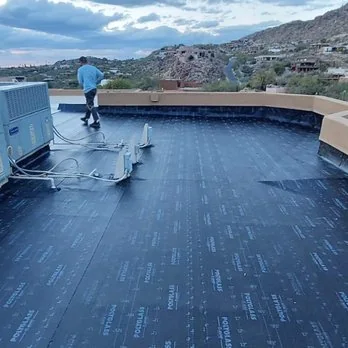
Reflective roof coatings
Roof Coatings
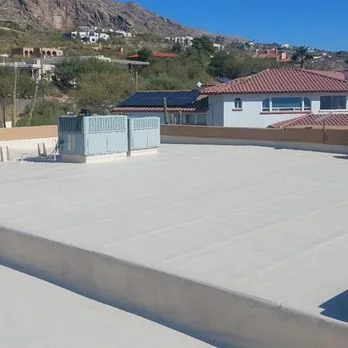
A reflective coating protects a flat roof from the sun and sends heat back off the building, as long as it goes over a roof that is sound. We make sure it is before a drop gets rolled on.
On a flat or low-slope roof, the sun is the enemy. UV breaks roofing materials down and summer heat bakes them day after day. A reflective coating is a thick, seamless layer, usually white, applied over the roof surface to take that punishment instead. It reflects sunlight and heat back off the building rather than letting the roof and the rooms below soak it up.
Signs you need it
- Chalk on your fingertips Run your hand across an old coating. If it comes away white and powdery, the coating is chalking, weathering away a little at a time, and it is thinner now than when it went on.
- A web of fine cracks Hairline crazing means the coating has lost its flexibility. It can no longer stretch and shrink with the roof through Tucson's daily heat swings, and those cracks will keep opening.
- Peeling sheets or bare patches Coating lifting away in sheets usually points to poor prep or poor adhesion the first time around. Every bare spot leaves the material underneath fully exposed to the sun.
- Exposed foam or bare membrane On a foam roof, tan or brown foam showing through means the UV protection is gone and the foam itself has started to break down. On a cap sheet or built-up roof, bare material means the same clock has started.
Gutters & downspouts
Gutters
Installation, repair, replacement, and cleaning in aluminum or steel, sized for the roof above and the monsoon storms that test it.
In Tucson, gutters sit idle most of the year and then get tested all at once. A monsoon cell can drop a lot of rain in a very short time, and every square foot of roof collects it and sends it somewhere. Without gutters, that somewhere is the ground right at the edge of the house: splashing the stucco, cutting trenches through the landscaping, and soaking the soil against the foundation.
Signs you need it
- Water sheeting over the front edge If water pours over the lip of the gutter instead of down the spout, the run is undersized, clogged, or pitched the wrong way, and it is sending that water right back against the house.
- Sagging runs or drips at the seams A gutter pulling away from the fascia, or dripping from its joints, has loose hangers or failed seals. The weight of standing water makes both worse with every storm.
- Peeling paint or dark stains on the fascia Water getting behind a gutter shows up on the fascia board first. Left alone, it rots the wood the gutter hangs from, and then the fix involves carpentry as well.
- Erosion, splash marks, or pooling at the foundation Stained stucco, washed-out gravel, or a trench in the landscaping below the roof edge means water is landing where it should not. Either there is no gutter there, or the downspout is dumping it back against the house.
What we handle
Skylights
Skylights
Skylights almost never leak through the glass. They leak at the edge, where the curb and flashing tie into the roof, so that is where we repair them and how we build them.
A skylight is a hole in your roof with a window in it, and the roof around it has to be built to handle that. The unit sits on a curb, flashing ties the curb into the surrounding roof, and a seal keeps the glazing tight to the frame. When a skylight leaks, it is almost always one of those three, not the glass.
Signs you need it
- Stains on the drywall around the shaft Water marks at the corners of the skylight well usually mean the flashing or curb seal has failed and water is running down the outside of the frame.
- A drip only in wind-driven rain If the skylight stays dry in a light shower but leaks when monsoon rain comes in sideways, the flashing on one side is not lapped properly. It is a classic flashing failure, and a very fixable one.
- A cloudy, yellowed, or crazed dome Acrylic breaks down under UV. Once a dome turns hazy or develops a web of fine cracks, it is getting brittle, and one hailstone or falling branch can finish it.
- Water on the frame on cold mornings Moisture beading inside the frame on a winter morning is often condensation, not a leak: warm indoor air meeting a cold surface. It is worth telling the two apart, because the fixes are completely different.
What we handle